
Both claim "Himalayan" — but Kumaon and Kashmir honeys come from different altitudes, flora, and supply chains. Here's what actually separates them.
The word "Himalayan" on a honey label doesn't mean much by itself. It's a geography so vast — stretching across five countries, dozens of distinct ecosystems, and hundreds of bee populations — that two honeys can both be called Himalayan and taste, look, and perform completely differently.
The two most prominent Indian Himalayan honeys are from Kumaon (western Uttarakhand) and Kashmir (Jammu & Kashmir). Both are produced at altitude. Both come from regions with rich floral diversity. But the differences in terroir, bee species, floral sources, altitude, and supply chain integrity make them genuinely distinct products.
Here's a clear-eyed comparison.
What makes Himalayan honey different from plains honey?
Before comparing the two regions, it's worth understanding why altitude honey commands a premium at all.
Bees foraging at 3,000–7,000 feet (roughly 900–2,100 metres) have access to floral sources that simply don't exist at lower elevations. In the Himalayas, these include rhododendron, buckwheat, wild berry flowers, thyme, clover, and dozens of endemic alpine wildflowers. The result is a more complex, multi-floral honey with a flavour profile that can't be replicated in the plains.
Additionally:
- Lower agricultural pressure — high-altitude regions have far less large-scale farming, which means less pesticide and herbicide exposure in the bees' foraging range. This directly reduces chemical residue in the honey.
- Smaller, more isolated bee populations — isolation reduces disease transmission between hives. It also means beekeepers have less incentive (and less access to) antibiotics and veterinary chemicals used in commercial apiaries.
- Lower water content — honey produced at altitude and in drier Himalayan conditions typically has a lower moisture content (often under 18%), which improves shelf life and reduces fermentation risk.
Both Kumaon and Kashmir benefit from these altitude advantages. Where they differ is in specific flora, bee species, and market maturity.
Kumaon honey: the Uttarakhand terroir
Kumaon is the southern division of Uttarakhand, bordered by Nepal to the east and Tibet to the north. The dominant altitude range for beekeeping in Kumaon is 3,500–6,500 feet — high enough for a cold, clean environment, but accessible enough for year-round management.
The primary bee species in Kumaon is Apis cerana indica (the Indian hive bee), a smaller, more defensive species than the European honeybee, but one that's extraordinarily well-adapted to the Indian Himalayan climate. Some operations also work with Apis dorsata (the giant rock bee), which produces high-volume, highly aromatic honey from the cliff faces it nests on.
The flora of Kumaon includes: - Rhododendron arboreum (buransh) — the state flower of Uttarakhand; blooms in spring and gives a distinctive floral note - Buckwheat — a common crop rotation plant in the region; produces a darker, more robustly flavoured honey - Wild herbs — thyme, mint, and several endemic alpine species - Multiflora wildflowers — the defining characteristic of Kumaon honey is its wildfloral complexity, since bees forage from dozens of species simultaneously
Kumaon honey is typically amber-coloured to dark golden, with a layered, sometimes slightly tangy flavour. It crystallizes at a medium pace and has a strong, persistent aroma.
The supply chain in Kumaon has been shaped significantly by the Self-Help Group (SHG) model — women's collectives that manage hives collectively and sell through direct channels or organized aggregators. This model is generally associated with shorter supply chains and less processing, since the SHGs have an incentive to maintain quality and traceability.
Kashmir honey: the acacia advantage
Kashmir is better known for one specific honey type: Acacia honey (from Robinia pseudoacacia, also called false acacia or black locust). This is the honey that has made Kashmiri honey famous internationally, and for good reason.
Acacia honey has an unusually high fructose-to-glucose ratio, which means it: - Remains liquid far longer than most honeys (fructose inhibits crystallization) - Has a very light, mild, nearly water-white colour - Has a delicate, clean sweetness with almost no floral aftertaste - Has a low glycaemic index for honey, around 35–42
These properties make Kashmiri acacia honey a premium commodity — it's consistently one of the more expensive honeys in Indian retail and is exported to Europe and the Middle East.
Kashmir also produces Multifloral Himalayan honey from higher altitudes — typically darker and more complex than acacia — but the acacia variety is the product most strongly associated with the region's honey identity.
The Kashmiri honey industry is well-established. Several FSSAI-registered producers have been operating for decades, and the export infrastructure is more mature than in most other Indian honey-producing regions. The trade-off is that "Kashmir honey" is frequently mislabelled in the Indian market — the premium commanded by the name creates an incentive for adulteration and geographic fraud.
How to choose between them
The right honey depends on what you're looking for:
Choose Kumaon multifloral honey if: - You want complexity — a honey that tastes of actual flora, not just sweetness - You prefer a robust aroma and a honey that pairs well with foods - You care about supply chain traceability and sourcing ethics (SHG model) - You're using honey for its bioactive properties — enzyme activity, antioxidants, antimicrobial compounds — since multifloral honeys from mixed floral sources tend to have higher polyphenol content than monofloral varieties
Choose Kashmir acacia honey if: - You want the mildest, most neutral flavour — good for people who find wildflower honey too strong - You want a honey that stays liquid (useful for liquid applications like drinks and dressings) - You prefer a very light colour and lighter taste in baking or cooking - You're looking for a very low-GI honey specifically
Both are legitimate, high-quality choices when sourced properly. The key word is "properly." Both regions have significant adulteration and mislabelling problems in the Indian retail market.
The adulteration problem with "Himalayan honey"
A 2020 CSE investigation found that 77% of honey samples tested in India contained undisclosed sugars. Both "Kumaon" and "Kashmir" honey is frequently counterfeited.
The only reliable way to verify geographic and purity claims is NMR spectroscopy — Nuclear Magnetic Resonance testing, which can fingerprint both the sugar composition and the floral markers of honey to confirm origin. FSSAI currently mandates NMR testing for exported honey; domestic standards are catching up but not yet equivalent.
When buying either Kumaon or Kashmir honey, look for brands that: - Publish NABL test certificates (not just the NABL logo) - Specify the exact testing parameters covered - Can name the specific district or cluster where the honey was sourced - List the bee species and altitude range
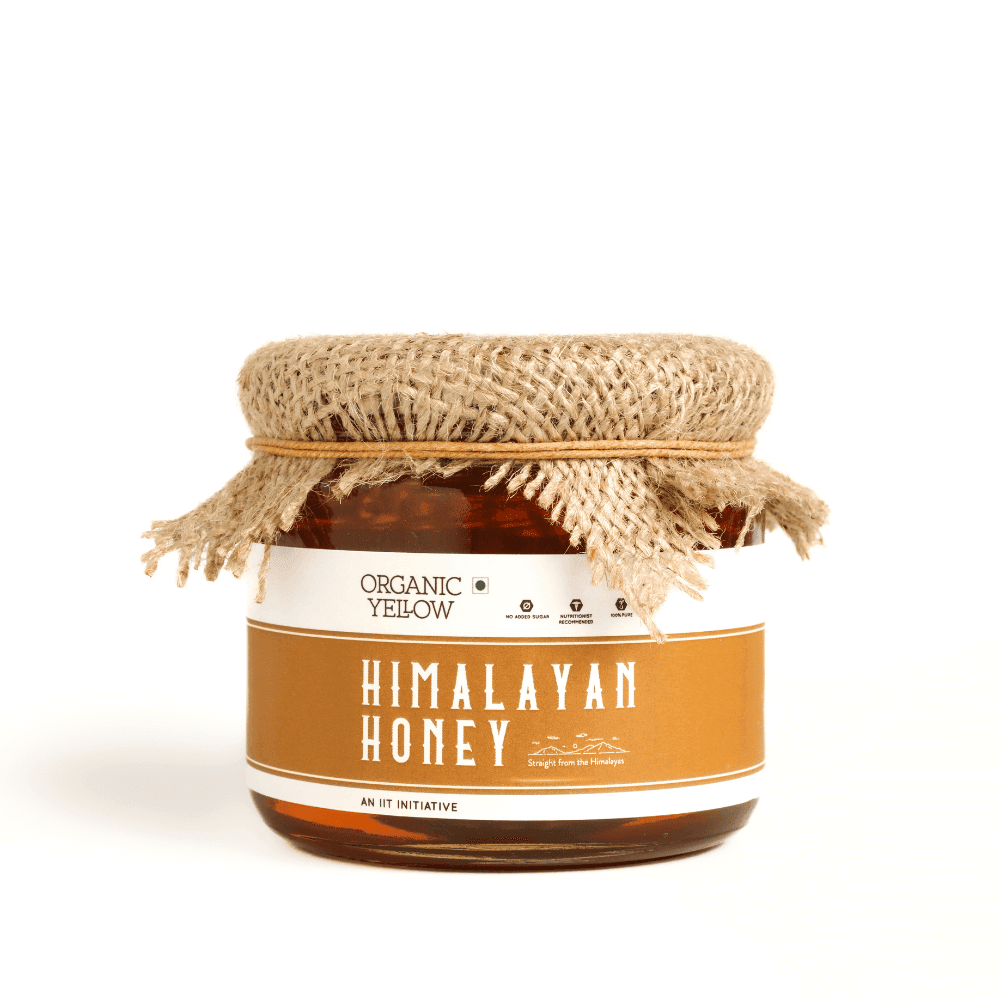
Organic Yellow's Himalayan honey sticks are sourced exclusively from SHG beekeepers in Kumaon at 4,000–6,000 feet. Our purity score is 98/100 across 8 NABL-certified parameters, including NMR-based C4 sugar testing. Lab certificates are available on request.
The bottom line
Kumaon and Kashmir honey are both genuinely exceptional when sourced correctly. They represent different flavour profiles and different use cases — Kumaon for complexity and bioactivity, Kashmir acacia for mildness and stability.
What they share is a susceptibility to the same problem that affects most premium Indian foods: the premium they command creates an incentive for adulteration that only rigorous third-party testing can address.
Buy from brands that can show you their lab reports. The certificate matters more than the mountain.