
Honey found in 3,000-year-old Egyptian tombs was still edible. Yet most honey jars have a "best before" date. Here's what's actually going on.
Archaeologists excavating Egyptian tombs have found pots of honey that are over 3,000 years old — and still edible. This is not an urban legend. It's one of the most remarkable examples of natural food preservation known to science.
And yet, your honey jar probably has a "Best Before" date of 2 years. What's going on?
The short answer: genuine raw honey essentially doesn't expire. The "Best Before" date is a regulatory requirement, not a reflection of actual spoilage risk. But — and this is important — most honey sold in India is not genuine raw honey. And some of it can absolutely go bad.
Why pure honey doesn't spoil
Honey is, chemically speaking, a hostile environment for microbial growth. Three properties make it naturally antimicrobial:
1. Very low water content Honey typically contains 17–20% water. Bacteria and fungi need a water activity (aw) above about 0.91 to survive and reproduce. Properly harvested honey has an aw of around 0.6 — far below the threshold for microbial growth. This is the most critical factor in honey's longevity.
2. High acidity Raw honey has a pH of approximately 3.2–4.5, making it acidic enough to inhibit most bacteria. This acidity comes partly from the organic acids naturally present in nectar and partly from gluconic acid, produced when glucose oxidase (a bee enzyme) breaks down glucose.
3. Hydrogen peroxide production Glucose oxidase also produces hydrogen peroxide as a byproduct — a slow, dilute, controlled antimicrobial agent. This is one reason raw honey has been used in wound care for centuries: it creates an environment where bacteria can't proliferate.
A 2011 paper in the Asian Pacific Journal of Tropical Biomedicine documented honey's activity against a broad spectrum of pathogens, attributing it to these combined properties.
FSSAI mandates a minimum Diastase Number (DN) of 3 for honey sold in India — a proxy measure for enzyme activity. Genuine raw honey typically scores 8–15+. This enzyme activity is part of what keeps the honey stable.
When honey does go bad
Here's the nuance: adulterated or low-quality honey absolutely can go bad.
The key variable is water content. Bees naturally cap honeycomb cells only when the moisture content drops below about 20%. Uncapped ("green") honey, harvested before this point, has higher water content — sometimes 25% or above. At this moisture level, honey is susceptible to fermentation by naturally occurring yeasts.
Fermented honey doesn't smell or taste like honey. It smells sour or alcoholic (because fermentation produces ethanol), has a foamy top, and may have an off-taste. This is genuinely spoiled honey.
Similarly, honey that has been adulterated with sugar syrups or glucose solutions often has higher effective water content and is therefore more vulnerable to fermentation. The diluted sugar mixtures have different water activity profiles than pure honey — and some are hospitable to microbial growth.
This is why adulterated honey has a shorter effective shelf life than pure honey. The "Best Before" dates you see on commercial honey are designed to account for the reality that not all honey is as pure as it should be.
Crystallization: not the same as spoilage
One of the most common honey misconceptions in India is that crystallized honey has gone bad. This is false — and it's worth being emphatic about it.
Crystallization is a natural, inevitable process that happens when the glucose in honey precipitates out of solution and forms crystals. It's a sign of real honey, not a defect. Honey that never crystallizes (highly processed, ultra-filtered commercial honey) has often been treated specifically to inhibit this — which, paradoxically, makes it less natural.
Factors that affect crystallization rate: - Glucose to fructose ratio: higher glucose = faster crystallization. Rapeseed honey crystallizes quickly. Acacia honey (high fructose) stays liquid much longer. - Storage temperature: honey crystallizes fastest at around 14°C. Cold refrigerators slow crystallization. Warm temperatures (above 25°C) slow it but also degrade enzymes over time. - Pollen content: pollen particles act as nucleation sites, accelerating crystallization. Ultra-filtered honey with no pollen crystallizes very slowly.
If your honey has crystallized, it's fine. You can re-liquefy it by placing the jar in a bowl of warm (not boiling) water until the crystals dissolve. Don't microwave it — the uneven heat will destroy enzymes.
How to store honey correctly
Proper storage maximises the shelf life of any honey, raw or processed:
- Store at room temperature — not in the refrigerator (speeds up crystallization without benefit) and not near the stove (heat degrades enzymes)
- Use a clean, dry spoon — introducing water through a wet spoon is one of the most common ways to trigger fermentation
- Keep the lid sealed tightly — honey is hygroscopic (it absorbs moisture from the air). An open jar in a humid kitchen will gradually absorb enough water to raise its water content above the safe threshold
- Store away from light — UV light degrades some of honey's antioxidant compounds over time
- Don't mix old and new honey — adding fresh honey to a jar with residue introduces new yeast cultures that can trigger fermentation
In a sealed container, stored properly, pure raw honey with low moisture content will outlast most of the things in your kitchen. Indefinitely, if the container is truly airtight.
What "Best Before" actually means for honey
FSSAI regulations require packaged food to carry a "Best Before" or "Use By" date. For honey, this is typically set at 2 years from packing — not because honey spoils at that point, but because:
1. Enzyme activity does gradually decrease — while honey won't spoil, its diastase activity (and associated functional properties) does decline over years, especially if stored in warm conditions 2. Regulatory compliance — the labelling requirement exists for all packaged food 3. Accounting for real-world quality variation — as noted, adulterated honey does have shorter shelf life
The "Best Before" on raw honey is a quality marker, not a safety marker. After the date, honey is likely still completely safe — it may just have slightly lower enzyme activity.
How to spot honey that's actually gone bad
Spoiled honey is easy to identify: - Sour or alcoholic smell — fermentation signature - Foamy surface — active yeast producing CO₂ - Watery or separated appearance — separation of water phase from sugar phase - Off-taste — sour, yeasty, or medicinal
None of these apply to crystallized honey, which looks opaque and grainy but smells and tastes normal.
The bottom line on honey shelf life
Genuine raw honey, harvested at the right moisture content and stored properly, doesn't expire in any meaningful sense. The 3,000-year-old Egyptian honey is the extreme case, but the chemistry is the same.
What expires is lower-quality honey — adulterated, diluted, high-moisture, improperly sealed. The "Best Before" date on your jar accounts for the reality that quality varies enormously across the Indian honey market.
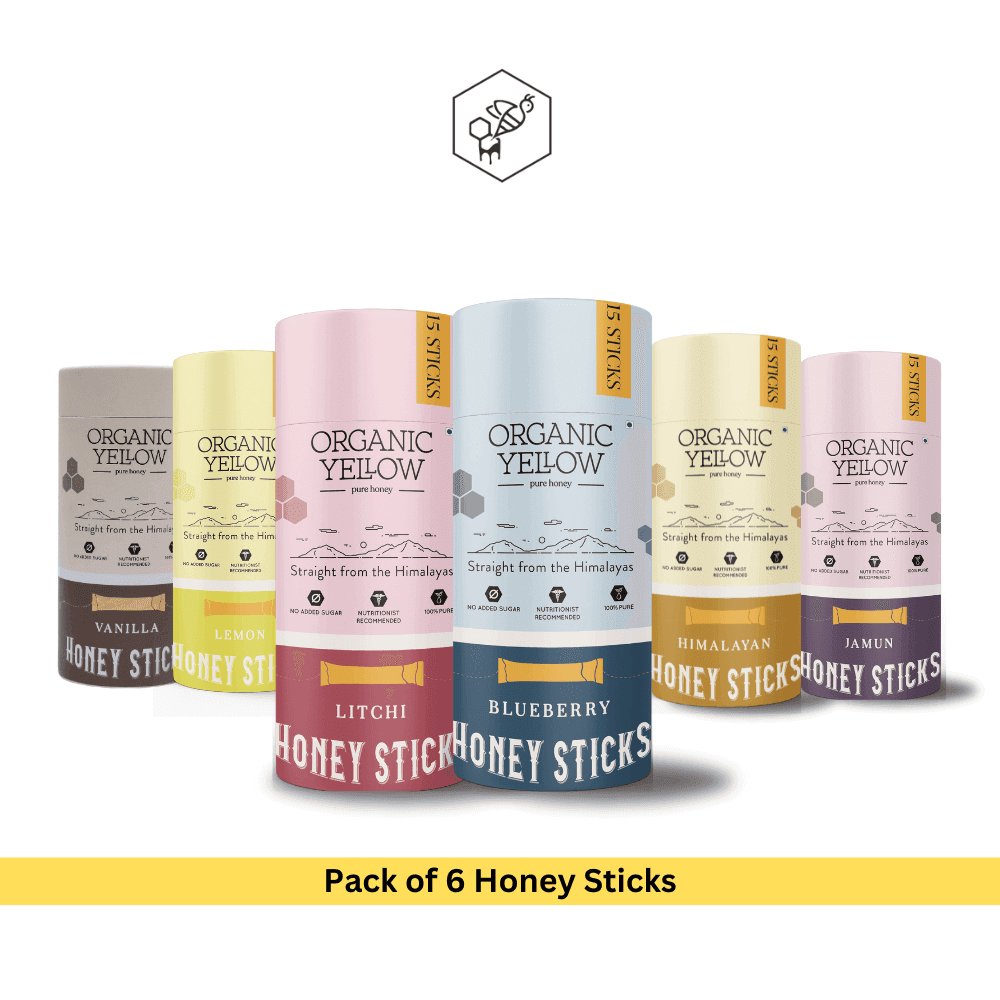
Organic Yellow's Himalayan honey is harvested below 20% moisture, cold-filled, and NABL-certified across 8 parameters. Our sticks are individually sealed, which eliminates the jar-contamination risk entirely — each stick is opened once, consumed, done. No wet spoons, no open jars near the stove, no contamination risk.
Buy good honey. Store it correctly. It will be there when you need it.