
Honey has a lower glycaemic index than sugar — but it's not sugar-free. Here's the honest answer on honey and blood glucose, with specifics on which honey types are safest.
India has the second-largest diabetic population in the world — over 77 million people managing blood glucose through diet, medication, or both. For this group, the question of whether honey is "safe" comes up constantly.
The answer is nuanced. Honey is not sugar-free. It is not a diabetic superfood. But it is genuinely different from white sugar in ways that matter — and for some people with well-controlled blood glucose, small amounts of the right type of honey can be part of a reasonable diet.
Here's what the evidence actually says.
Why honey isn't the same as sugar
White granulated sugar (sucrose) is a disaccharide — a molecule made of equal parts glucose and fructose joined together. When digested, it splits into 50% glucose (which enters the bloodstream immediately) and 50% fructose (metabolized in the liver).
Raw honey is more complex. It contains: - Approximately 38% fructose - Approximately 31% glucose - Approximately 17% water - Small quantities of sucrose, maltose, and other di- and polysaccharides - Enzymes, including invertase (which partially pre-digests the sugars), diastase, and glucose oxidase - Polyphenols, flavonoids, and organic acids - Trace minerals including zinc, magnesium, and potassium
The pre-digested sugar profile and the presence of enzymes and polyphenols affect how honey behaves in the body, specifically in relation to blood glucose.
The glycaemic index difference
Glycaemic index (GI) measures how quickly a food raises blood glucose relative to pure glucose (GI = 100). Higher GI = faster blood glucose spike = larger insulin demand.
- White sugar (sucrose): GI approximately 65
- Raw wildflower honey: GI approximately 45–58 (varies by floral source and processing)
- Acacia honey (high fructose): GI approximately 32–42
- Processed commercial honey: GI often higher, as processing can alter the sugar profile
The lower GI of honey means it raises blood glucose more slowly than sugar — which matters for people managing diabetes. A slower glucose rise gives the body more time to respond with insulin (or for insulin medication to act), and produces less of the extreme spike-and-crash cycle that damages blood vessels over time.
However — and this is critical — a lower GI does not mean zero impact on blood glucose. Honey still raises blood glucose. The difference is in rate and magnitude, not in binary safe/unsafe.
A 2004 meta-analysis published in Diabetes Care found that low-GI diets improved HbA1c (the 3-month average blood glucose marker) in people with Type 2 diabetes. Honey as part of a low-GI dietary pattern can contribute to this effect — but it's not a standalone intervention.
What happens in controlled studies
A 2012 clinical trial published in the Journal of Medicinal Food compared the effects of honey versus table sugar on blood glucose in diabetic and healthy participants over 8 weeks. Key findings:
- Honey caused a lower glucose rise and a lower insulin peak than equivalent amounts of sugar
- Fasting blood glucose, HbA1c, cholesterol, and triglycerides were lower in honey-consuming diabetic patients than in sugar-consuming patients
- In healthy individuals, both sweeteners produced similar outcomes
A 2017 review in Nutrients synthesized evidence from 18 randomized controlled trials and found that honey improved several cardiometabolic markers (total cholesterol, LDL cholesterol, triglycerides) while showing equivocal but generally better blood glucose outcomes than sugar.
The evidence base supports a cautious conclusion: for people with well-managed Type 2 diabetes, small amounts of raw honey (1–2 teaspoons, not tablespoons) as a replacement for equivalent amounts of sugar may produce modestly better blood glucose outcomes. This is not a license to consume honey freely.
Which type of honey is best for diabetics?
Not all honey has the same GI. The fructose-to-glucose ratio is the primary determinant:
- Higher fructose = lower GI — because fructose is metabolized in the liver without directly raising blood glucose
- Higher glucose = higher GI — glucose enters the bloodstream immediately
The implications:
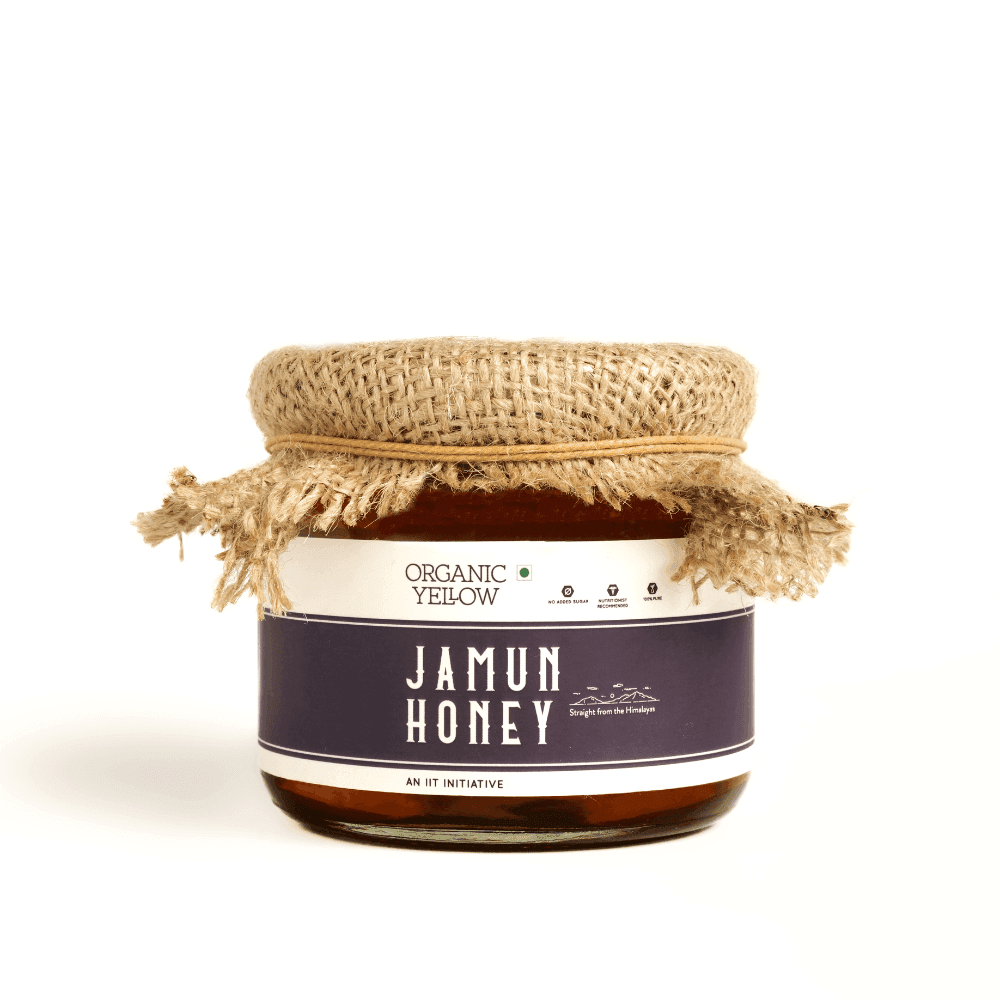
Jamun (Java plum) honey is one of the most discussed honeys in the context of diabetes in India — because jamun fruit itself has a long history of use in Ayurvedic diabetes management. Jamun honey, produced when bees forage on jamun blossoms, has a distinctive deep color and has been reported to have both a lower GI than standard wildflower honey and additional polyphenol content from jamun-specific compounds.
Scientific evidence specifically for jamun honey is limited — most of the jamun-diabetes research focuses on jamun fruit extract rather than bee-collected honey from jamun flowers. However, the theoretical basis for lower GI from jamun honey is plausible given its known floral source composition.
Organic Yellow's Jamun Honey Sticks are sourced from regions where Syzygium cumini (jamun) is the primary floral source during the spring bloom. NABL-certified across 8 parameters.
Acacia honey (Kashmir) has one of the lowest documented GIs of any honey variety — approximately 32–42 — due to its exceptionally high fructose content (up to 45%). This makes it the most conservative choice for people with diabetes who want to use honey as a sweetener.
Raw wildflower honey (like Organic Yellow's Himalayan honey) typically has a GI in the 50–58 range — better than sugar, but less conservative than acacia.
Processed commercial honey: avoid for diabetic use. Processing can alter the sugar profile and removes polyphenols, potentially raising the effective GI while eliminating the benefits.
Practical guidance for diabetics considering honey
How much is safe?
No universal threshold exists, because individual insulin sensitivity, medication type, and current blood glucose control vary. As a conservative starting point: 1 teaspoon (7g, approximately 21 calories) per day as a replacement for a similar amount of sugar — not in addition to your normal sugar intake.
Monitor your blood glucose response after consuming honey (2 hours post-consumption is the standard measurement window for postprandial glucose). If your blood glucose stays within your target range, small amounts are likely manageable. If you see a significant spike, reduce or eliminate.
Important caveats: - Never replace diabetes medication with honey - People on insulin or sulphonylureas should be particularly careful — these medications can cause hypoglycaemia, and adding any sugar source (including honey) without adjustment can cause glucose swings - People with very poorly controlled diabetes (HbA1c above 8%) should probably avoid honey until control improves - Consult your doctor or diabetologist before making dietary changes — the research supports the hypothesis, but your specific medication and metabolic situation matters
What about the "honey cures diabetes" claim?
It doesn't. There is no evidence that honey reverses diabetes or significantly reduces the need for medication. The evidence supports a more modest claim: that for people managing well-controlled Type 2 diabetes, honey is a somewhat better sweetener than sugar. That's real but limited.
The bottom line
Diabetics can eat honey — in small amounts, of the right type, as part of an otherwise low-GI diet, and with careful blood glucose monitoring. It is not a diabetic superfood, but it is genuinely different from sugar in ways that are relevant to blood glucose management.
Choose raw honey over processed. Choose high-fructose varieties (jamun, acacia) for the lowest GI. Start with 1 teaspoon per day. Measure your response.
The difference between honey and sugar for a diabetic is not zero — but it's also not unlimited license. Small amounts of good honey, used thoughtfully, can fit into a well-managed diabetic diet.